




What is an amalgamator?
If you have a tooth filled, then you have seen this device at least once in your life and experienced the technology behind it. When a tooth decays or breaks for any reason and a cavity or hole forms in it, it must be filled with a material that is compatible with the internal environment of the body. This material is called amalgam and is a gray-colored metallic compound.
The amalgamator, which acts as a mixer and blender, is used to help fill the tooth with amalgam. This chemical contains mercury, tin, copper, silver, lead, etc., and its most important physical weakness lies in its mercury. Because mercury hardens and dries quickly when mixed with other materials; for this reason, it is made into a solid mercury powder and is used as a dry powder when the dentist wants to use it. Therefore, to create the amalgam mixture and form the dough, an amalgamator is used, the general principles of which are similar to those of a mixer.

Various components of the device
- Powder holding tank and electric motor (usually 220 volts)
- Mixer
- Electronic board
- Timer
- Lever for determining the number of units
Everything about amalgam composition
From the perspective of physical properties, amalgam is a material that consists of two main metals: mercury and silver. Of course, other elements such as tin and copper are also added to it to create a series of properties. Amalgam exists in two parts, powder and liquid, before being combined. In the powder part, we have silver and a small amount of tin, and in the liquid part, there is liquid mercury metal.
The dentist first performs preliminary work on the decayed tooth or the fractured tooth, and after trimming the tooth, he prepares the area to accept the amalgam material. Then the powder and liquid amalgam are mixed together and create a paste mixture, which takes about 2 to 3 minutes to dry. Therefore, the dentist should take this opportunity to insert this material into the tooth cavity and create a suitable shape for it. After this time, this material begins to harden and a strong and stable alloy is created that is resistant to the humidity of the oral environment and the pressures caused by chewing food. Its average life can be estimated between 5 and 10 years depending on the quality of the materials used.
Alternatives to Amalgam
In addition to amalgam, there are other composite materials called tooth-colored restorative compounds, called composites, in the dental consumables market that are used to restore front teeth that are exposed. This material also seems to be a good choice in terms of appearance, but in terms of withstanding the pressures caused by chewing and its useful life, it is not very useful for providing the chewing surfaces of the back teeth and is not recommended.
Types of Dental Amalgamators
In general, there are two types of devices: composite and capsule.
1- Combined Amalgamator
This combined device works as follows: first, amalgam powder is poured into the chamber of the device and mercury is poured into a separate chamber. When the device is turned on, the powder and mercury are automatically mixed together in a ratio of 80% powder to 20% mercury.
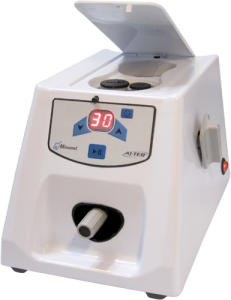
2- Capsule Amalgamator
In this type, the amalgam material is already embedded inside small capsules. In this capsule, there is a thin curtain that separates the mercury from the powder. The capsule is placed on the amalgamator device and when the device is turned on, the curtain is automatically removed and the powders, which are packaged in standard proportions, are mixed together. This model has more applications than other types of amalgamators.
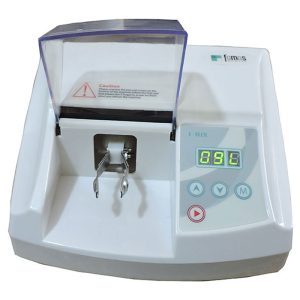
3- Combined Amalgamator – Capsule
The dual-function amalgamator (powder and capsule) has both high efficiency. In the combined capsule amalgamator, the amount of powder is variable and the amount of mercury is constant. The percentage of powder is also adjusted with the help of a volume located next to the device. In this way, by turning the volume to the positive or negative side, the amount of powder increases or decreases, respectively.
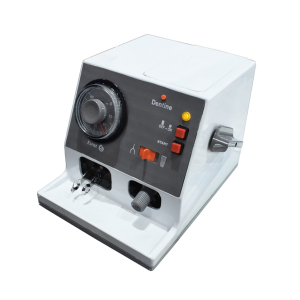
Function of the amalgamator
The amalgam composite material is in the form of a powder. To convert this powder into a paste, it is mixed with the liquid phase of mercury. Therefore, inside the device, there are separate tanks for placing the amalgam and pouring the mercury. First, we pour the amalgam and mercury into their respective tanks and then, using a special lever, we determine the percentage of their composition. In the next stage, these two phases are introduced into the mixer in a specified amount and at the end, the resulting mixture is transferred to the outlet of the device and is used.
Hygiene requirements for working with the amalgamator
After each use of this device, the inside of the tube and its cap must be cleaned with a special brush.
Before the tube cap is completely stopped, care should be taken to ensure that it never comes into contact with the hand.
This device should not be exposed to direct sunlight.
Once or twice a week, the device should be kept upside down and then put back in place. Due to the vibration of the device, the amalgam powder may be compressed at the bottom of its tank and therefore the amount of amalgam required for the desired composition may not be removed from it. In this way, the adjustment of the device will be disrupted. Therefore, this problem will be solved with these weekly shaking.






Reviews
There are no reviews yet.